Showing posts with label ghost towns. Show all posts

Friday, July 5, 2013

Divine Forces


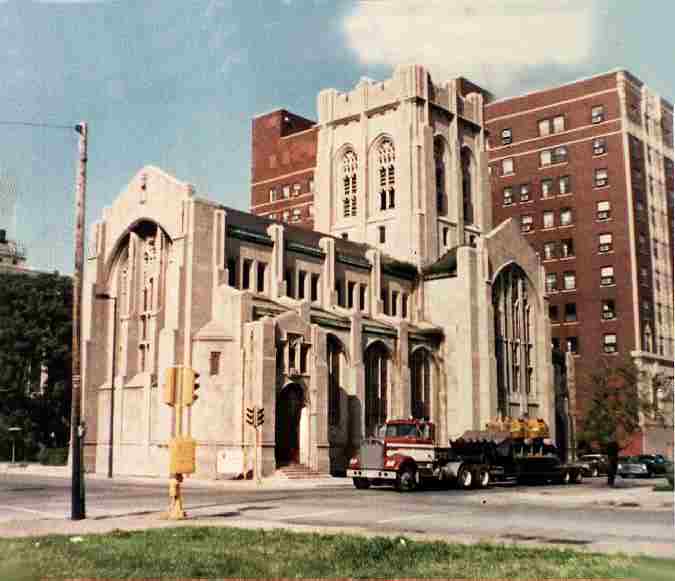
  The First Methodist Church of Gary, Indiana, or City Methodist Church as it was later known, was a testament to the faith, or at least the prosperity of Gary and it's populace. Half of the $1.3 million (1925 US dollars, mind you) was donated by the US Steel Works.
Photo © 2013 Tim Arends Used with Permission*. 


A photo by Tim Arends, of Preserve Indiana, shows the Sanctuary wing from outside in the early 80s.


Twas a Grand House of Worship Indeed. 


Opening in 1926, City Methodist was one of the first racially integrated churches of the time.


An innovative vision of Rev. Seaman,  "To Serve the Present Age," above the equality, he included an attached school,


And retail space at street level, below the educational wing that generated additional revenue for the church through the good times. Another historic photo from Preserve Indiana focuses us on this space, long ago;
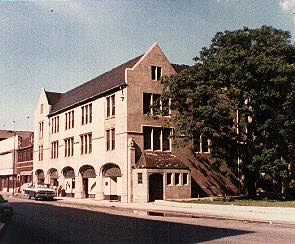
Photo © 2013 Tim Arends Used with Permission**. 
The retail spaces originally included in the church's design, are included in it's ruins today.


Re-purposed throughout their life, the litter and ephemera within the retail spaces today obscure most clues to what enterprises operated here through the years.


Rubble pile within a storefront along Washington Street


An auditorium suited to host film and staged productions was included in the design.
Five lonely chairs survive the vandals and elements the church has endured


 Creating an evening and weekend community center, just blocks from the heart of downtown.


Though the house is quiet, a visit to the Seaman Auditorium sets ones imagination afire


  The church was a credit to the Rev Seaman, his networking and fund-raising made this church possible, but this was no small feat. Some corners had been cut to meet budget, others were misplaced by oversight or accident.

The columns lining the sanctuary are one of the engineering oversights. One pair, larger than intended, their size prohibited the quantity of seating inside the church.

Important amenities were made possible through the good Reverend's works. A rooftop garden was included in the design, accessible from either wing via this bridge.


Wandering through the school levels we found a gymnasium on the 4th floor.
 
Rusty Metal screens fall slowly away from panels devoid of glass in the old gym doors


Most of the gym exposed to the sky and weather, weeds take root and rafters lie across the court.

Or remain propped upon the load bearing external wall


Above the gym a sketchy looking walkway connects the educational wing with the locker room areas.


The home and visitor locker rooms are up a small and winding stairway. The stairs tucked into a secluded corner, and lead to the highest accessible areas of the remaining structure.


Snow and Winter clouds clung to Northern IN this day

From the upper most locker/restroom, little of the roof remains to hinder views of the belfry, reaching nine stories into the Gary skyline.


 If you can find and summon the courage to test the catwalk, you're reward; that skyline view.


And majestic views into the sanctuary as well.


Opaque glass was used in lieu of stained glass in some portions of the cathedral windows as a way to keep costs under control.


 The remains of a stairway central to the church, rectory, school, and auditorium lie hidden deep within the building's ruins. Little light reaches this corner, but with patience one finds the colors as magnificent as any leaded glass piece you might commission.
The frugally commissioned stained glass maintains it's inherent grandeur, where it is intact, through the ruination of this beautiful old building.


Like most churches, this one has many side passages and stairways to explore.


Following them often leads to dead ends whether by design or decay, but the views most always astounding.


Which is not to say this house of worship was not adequately ornate, there were many unique decorations designed and crafted into this church.

Grapes and other signs of artistry decorate the stone and masonry


On a quiet Sunday morning Jezebel kneels in the ruins of the sanctuary as your Garrulous Sherpa provides overwatch
 
The scars of the abandoned life are unlikely to heal here though
 A fire-side study for the parson perhaps? Interior walls have been removed by vandals while wooden doors have swollen tight into their frames.
 
After a few hours touring the upper levels of City Methodist in early December, the team returned to the ground floor to find the decorations had been hung with care in this room pictured as we exited below the view as we'd entered only hours earlier.
This visit in March, a few months is an eternity to a ruin exposed to the elements, atmospheric and human, and the subsequent disquiet that follow them, seems eternal at times

Vagrants, addicts, those otherwise homeless, and Urbexers posing for their Facebook friends help the remaining fixtures migrate around the ruins in this old church


Ephemera from original use co-mingles with eclectic odds-n-ends brought into these ruins in this old cabinet space

 For more history and pictures of the City Methodist Church through the years visit the following links, and see more of Jezebel Marie's photography at AmericanRuins on Facebook.


 http://www.faithfabric.com/tbh/gary/images/67directory/03began.jpg

http://www.faithfabric.com/tbh/gary/67directory.htm

http://www.preserveindiana.com/pixpages/nw_ind/garypix.html

http://chicagoist.com/2009/09/02/in_the_shadow_of_chicago_city_metho.php#photo-14

Links and citations below for the Preserve Indiana pictures used in this article. Visit Tim's page, and see how you can help to preserve sites such as this one for future generations to witness and study and appreciate.  As Utah Phillips said, 'Time is an enormous long river, and I am standing in it just as you are standing in it." We're all in this together, help out those whom you find worthy toward a better tomorrow!

Until next time, Stay off the Radar...

The Garrulous Sherpa marvels at the Neo-Gothic architectural details around the Sanctuary space


** Arends, Timothy. "City Methodist Church, Gary, Indiana - commercial office space." Photo. preserveindiana.com undated, 28 Jan 2013 <http://www.preserveindiana.com/pixpages/nw_ind/garypix.html>

* Arends, Timothy. "City Methodist Church, Gary, Indiana." Photo. preserveindiana.com undated, 28 Jan 2013 <http://www.preserveindiana.com/images/downtowngary/methchur.jpg>

Many Thanks Tim Arends for the permission to use the images and your reminiscences of Gary through your years.


Friday, February 8, 2013

Techonological Forces (aka ARTV is Here!)


While I hate to have left you in limbo for so long, I'm ashamed to admit I've run up against a horrid case of the writer's block in trying to articulate how awesome and impressive the ruins of the City Methodist Church were to behold, and have yet to undertake words equal to the images Jezebel captured there. In the meantime, I've completed a video montage of an exploration into what we'd found and termed a "hotspot" during a reconnaisance of the rust belt via Google Earth on a 42" LCD. Allowing us to follow the remnants of a railroad bed we'd run across in town, but hadn't identified the former destination. They ended up leading into the south end of a massive hulk of ruin sitting at the corner of 7th & Alabama;


Part One takes you through the approach and administrative areas, with a peek into the yard.


Part two starts in the yards and explores the upstairs maintenance/fulfillment area and employee bathrooms where talented taggers have created a color menagerie we were lucky enough to capture reflected around the room by a coating of ice dripping in through the breached ceiling.


There is a third video in the set, it's upload is completed but the link to share it with you is not active just yet. As I'm packing up to head for that church again in the morning, I'll leave you to explore the channel and there is a playlist to go through all three of them in succession.

We'll be back soon with an intriguing look at that church, a narrative to the sites in this video, and more in the coming weeks.

Until next time, stay off the radar!


Saturday, January 26, 2013

Economic Forces


An April 1984 F4 tornado tears through Mannford, OK
 I grew up in a dead town. We all thought it was dying, but having been back once a decade or so since Old Man and Momma Jones took down the shingle and meandered us westward; I can see it was dead when the water slide closed down. Those left either never wanted to be in town anyway, or stumble around zombie-fied recalling the last time the Pirates made a run at the Oklahoma State 1A High-School championship, as a measure of persistent relevance.

They mean football, but no team had been to state in anything except marching band for decades. Held together with sludge leftovers of the oil boom, the original town site flooded by a Corps of Engineers dam on the Arkansas river west of Tulsa. The ground so polluted, in a pre-EPA America even, recourse was burial at minimum 15 feet underwater. I thought of it as a suburban experience, since Old Man Jones commuted to Tulsa. Later I met true suburbanites and learned the equine facilities in our back pasture, let alone the back pasture, disqualified me from the normal perception of suburban. Sparse population-density tends a balance that keeps most of the residential and commercial space occupied, each spring tornado season erases another swath of town, only the necessary buildings get recreated.

Inside Gary's Union Station
 This was never an economic hub, like the refinery town where my grandparents lived. Though it still had some vibrance and character when I was young, the brick-streets of Ponca City continue to deteriorate and remain underfunded now that I'm, ahem, less young. As time wears on the sheen fades, and facades begin to dull.

 The Continental Oil Company didn't hold a candle to the United States Steel Corporation's testament to civilization plotted out of northwest Indiana. Named in honor of their founder Elbert Henry Gary, a capitalist mogul of the first order, having coordinated the likes of JP Morgan, A. Carnegie, and C. Schwab to launch the steel company and the city where its labor force would flourish.


Union Station, Gary, Indiana, where the trains no longer so much as slow down

Friday, December 14, 2012

If That Train Had Come

 Downtown Bachelor's Grove, the intersection of 135th & Bachelors Grove Road, a densely populated couple of blocks and a surrounding area of immigrants, homestead-farmers. Some more well connected than others, but all waiting for the train tracks to be laid through their hamlet. With beginnings sometime in the early 1800s in the southwest section of what is today Cook County, IL, pictured above was the main drag.  

  "Though the earth and all inferior creatures be common to all men, yet every man has a "property" in his own "person." This nobody has any right to but himself. The "labour" of his body and the "work" of his hands, we may say, are properly his. Whatsoever, then, he removes out of the state that Nature hath provided and left it in, he hath mixed his labour with it, and joined to it something that is his own, and thereby makes it his property" - John Locke on Homesteading

Nature Forces

Some areas are abandoned due to forces of nature, voluntarily or otherwise - Mother Nature will displace you if you won't heed the warnings and nature's alarms.Ask Harry Truman, not the president, but the last resident of Spirit Lake. That's not Spirit Lake there, that's the new lake that formed 150' of mud and volcanic ash above Harry R. Truman's last known whereabouts, at the Mt. St. Helens Lodge at Spirit Lake.

Thursday, December 13, 2012

Native Forces


Frank Peters was a man of means, a self-made Chicago attorney. Befriended by the Alexian Brothers, an Augustinian Order, when he was a boy, Frank never forgot. Upon his death he left plans in motion to establish a palatial home for his beloved wife, Jeannie, ahem..Mrs. Frank Peters (as documented in 1939 records and newspapers) and their invalid daughter, Jane, with the caveat that after habitation by his immediate family the property be a donation to the Alexian Brothers, who made use of this property as a Novitiate from the early 1950s until the late 1960s according to Mr. Peters wishes.


Jeannie occupied the home from it's completion in 1939 through 1948, though Jane passed away before the home could be occupied.


The first of many unfulfilled hopes surrounding this place.


The "monastery" rests atop a knoll alongside the Red River, overlooking a rapid named Monastery Falls for the behemoth, remote structure riverside. It was indeed a Novitiate, a training ground for novices, while in Alexian hands. The buildings doubled in capacity through additions by the Alexian Order, who took over the property in 1948 and hosted it's first class of novices in the early 1950s. Whom needed dormitories and classrooms and dayrooms and rec rooms.

Their are pictures of the building in it's expanded glory through the links at the end of this article.


The lands, however, were claimed by the Menominee Indians as tribal and through treaties and agreements with the government over the years. The Menominee wanted to see a tribal hospital established within the facility upon the Alexian's departure, though actions indicating the property would be sold at market were agitating many holding such hopes.


This agitation boiled over into an armed takeover of the property in 1975 by a more assertive, dissident faction from the tribe, demanding the property be deeded to the tribe. This band, 'The Menominee Warrior Society' and the tribe had been victim of, yet persevered through the failed "Termination" movement. Now this dissident faction took it upon themselves to acquire the abandoned property in hopes of conversion to a tribe hospital.


Photo © Al Bergstein, 1975, Used with permission, albergstein.com, http://www.albergstein.com/page7/page7.html
The Menominee had been adjudged one of the most viable tribes, for adoption of the US civil norms of the mid-1900s, to be included in this experimental movement. A gross miscalculation by the Bureau of Indian Affairs that left the county of Menominee markedly the poorest in the state. With a less than stellar record of fulfilling obligations from historical treaties with native tribes, the federal government harbored little faith or support amongst the people of the Menominee nation. Exercising any control over this dissident faction by tribal elders would prove difficult without substantive leverage.

The Lil Ruiner watches the road from the footsteps of history

Al Bergstein recounts photographing Marlon Brando before this fireplace, and mentions the room behind it where one was visible to the armed locals surrounding the novitate; " It was  a place where you kept your head down and walked at a crouch. "


 They then further exacerbated the plight of the cash strapped Menominee Restoration Committee with the eventual ascent to the demands of the self-annointed Menominee Warrior Society and granted deed to the Novitiate and the surrounding acreage to the tribe.


Time, elements, and vandals leave the only traces of change inside

Though studies by state and federal agencies had already estimated a steep price tag to convert this building into either an educational or medical institution as the Warrior Society had seemed intent in its demand, the tribe now held the tab for accruing property taxes on a substantial piece of northern Wisconsin.

Unable to sustain the upkeep, let alone pursue upgrade whilst in the midst of this "Restoration" effort thrust upon them, an ugly side of our history we continue to mis-handle and re-frame today, and continues to plague reservation communities across the nation, the building fell into disrepair and is not on tribal lands today.


The Novitiate has been left to the elements, and the inevitable spray-painting vandals. Minimally disturbed, thanks in large part to it's remote location, the remaining skeleton is built to withstand the elements of time, even as it's decorative artifacts decay under the duress of long winters, harsh swings in temperature along with significant humidity and precipitation with heavy melt and run-off cycles, as well as indifference from the system that made many promises to the people who were the rightful heirs to the land where this structure, that could have been so much more useful, now stands.


Add caption


Photo linked from Alexian Brothers online Archive for comparison
An incredible look inside the 1975 Menominee Takeover is available at Photojournalist Al Bergstein's Site

And reading from the historical Christian mission to Natives perspective is recounted here

Along with a video by a former novice who left the order but returned to find that he'd missed some interesting history, so made a documentary on the siege;