Showing posts with label photography. Show all posts

Tuesday, October 15, 2013

Communal Forces


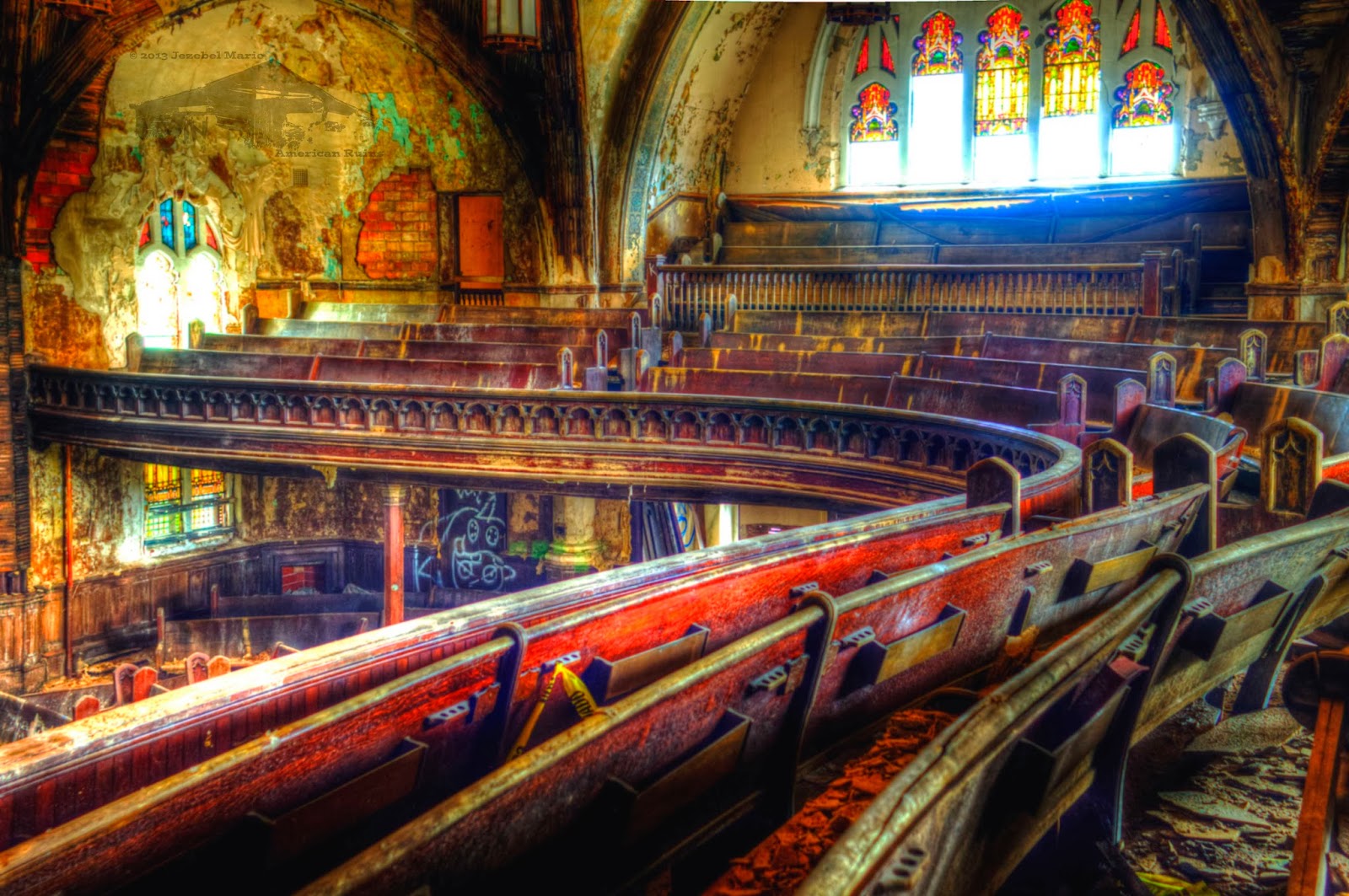
 My new happy place is at church. Not the defined rites and rituals and finery that constitutes church for some, but the ruins of such pageantry. Not a specific building, like the Nazarene Church on NW 39th St of my forebears, but any carapace of character quietly fading into the urban landscape. Dulling beauty.


Whenever we hit up a new town we always search out churches. Pillars of communities, touching so many souls across multiple generations, their residual energy is palpable and exhillirating.

This summer has seen a number of miles chocked up in the AR mobile. From Mobile to Monroe, through St. Louis and Detroit. We visited grand cathedrals and road side chapels. In the Carolinian mountains, along the battered Gulf coasts, on the muddy banks of the Mississippi, everywhere we traveled we found monuments from mankind to their master. Massive architectural icons lining Woodward Ave, Clapboard steeple topped sharecropper churches alongside forgotten county roads in Alabama, modest inner-city structures re-purposed before abandonment and succumbs to decay in all metropolitan areas.

A quiet spot in front of St. Mary's in Detroit, MI


We're tourists, so we should travel. Roaming the ruins of Detroit we found community in  isolation as multiple paths converged one summer Saturday.


The craftsmanship, the thoughtfulness and expression in the design of these buildings is renowned. Their state of neglect and disrepair nearly as so.

The Sherpa is not getting any younger, I'll never see Langston Hughes read in Harlem nor the Grateful Dead play the EastTown, my hope for tickets to a reunion tour by The Ramones has waned. Every day the news brings word another of these great buildings has had demolition permits issued.


The state of the motor city is not lost on us, the depression there is a harbinger of the troubles to plague us all if we allow capitalism and cronyism to run rampant. As America has shown wont to do.


The majority of folks left in Detroit are too poor of resources to move, and sentenced to the fate of the city. Small pockets of vibrant, metropolitan life populate an apocalyptic landscape of razed and overgrown lots, derelict ruins of yesteryear's industry, the sad, gaudy lights and colors of Payday Loan brokers like beacons in seas of broken and falling homes.

 The place is an explorers paradise though, visions of the history and lives that passed through the city, when crowned the nation as a shinier jewel, dance everywhere one goes in the motor city. Derelict and weathered buildings and lands narrate historic times higher on the hog that is the American economy.

Landmarks, icons, monuments to man's love of his creator. These churches sit silently now, deterioration hurried by water and scrappers and vandals.

 Architectural wonders.


 Engineering curiosities.


Internet precursors.


 All wasting assunder.

 Along with their facilities.


 And parsonages.


 And ephemera.


  Amazing and ornate details.


Instruments and stained glass creations await desecration.
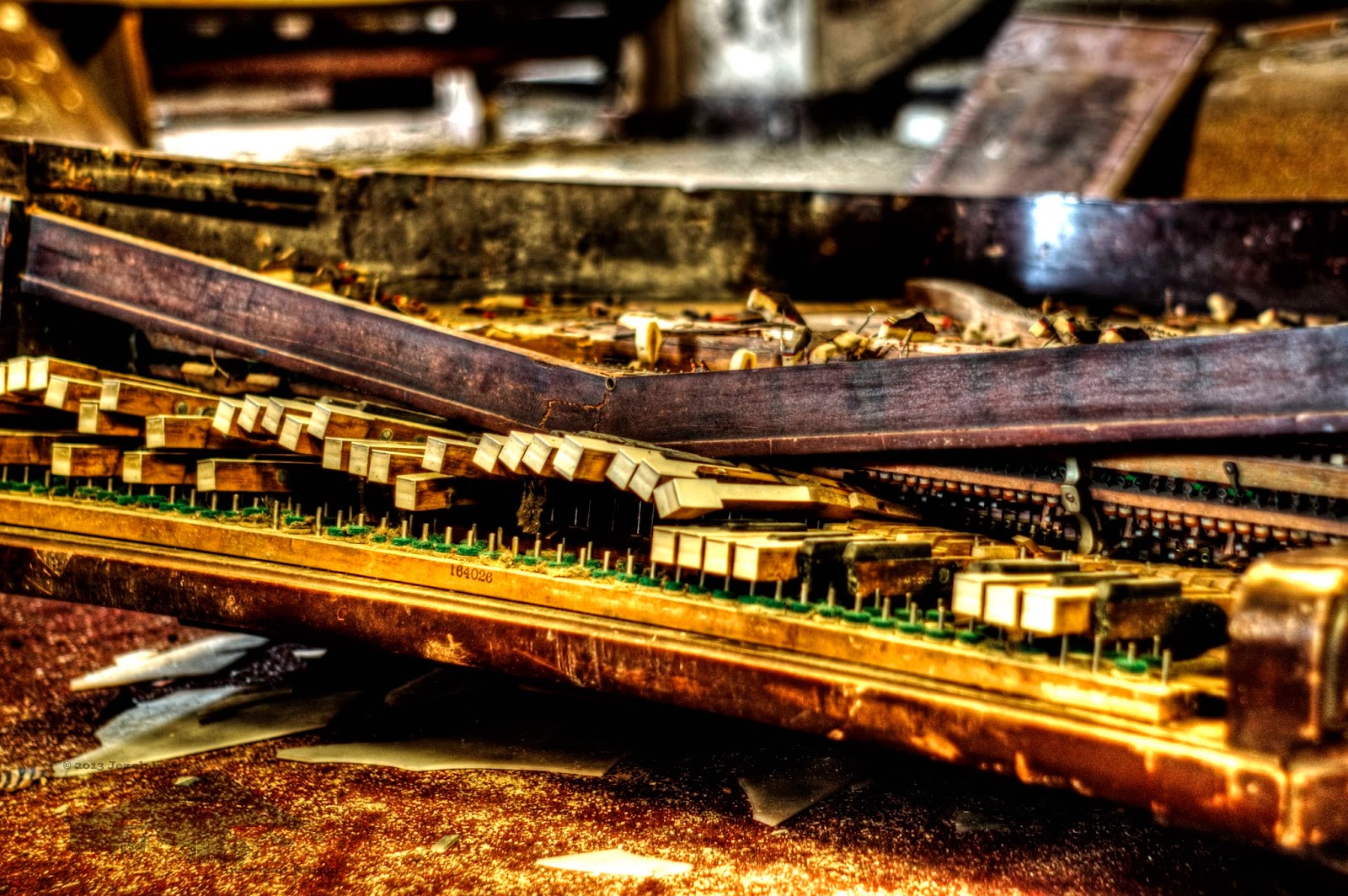


Or redemption.


All standing in defiance of abandonment and weather, glorious ruins from substantive times and materials welcome the explorer.


We'll look deeper at Detroit and the histories of these and other abandoned spaces around the city. Until next time, stay off the radar!


Friday, February 8, 2013

Techonological Forces (aka ARTV is Here!)


While I hate to have left you in limbo for so long, I'm ashamed to admit I've run up against a horrid case of the writer's block in trying to articulate how awesome and impressive the ruins of the City Methodist Church were to behold, and have yet to undertake words equal to the images Jezebel captured there. In the meantime, I've completed a video montage of an exploration into what we'd found and termed a "hotspot" during a reconnaisance of the rust belt via Google Earth on a 42" LCD. Allowing us to follow the remnants of a railroad bed we'd run across in town, but hadn't identified the former destination. They ended up leading into the south end of a massive hulk of ruin sitting at the corner of 7th & Alabama;


Part One takes you through the approach and administrative areas, with a peek into the yard.


Part two starts in the yards and explores the upstairs maintenance/fulfillment area and employee bathrooms where talented taggers have created a color menagerie we were lucky enough to capture reflected around the room by a coating of ice dripping in through the breached ceiling.


There is a third video in the set, it's upload is completed but the link to share it with you is not active just yet. As I'm packing up to head for that church again in the morning, I'll leave you to explore the channel and there is a playlist to go through all three of them in succession.

We'll be back soon with an intriguing look at that church, a narrative to the sites in this video, and more in the coming weeks.

Until next time, stay off the radar!


Monday, January 28, 2013

Bureacratic Forces (or Paranormal Forces?)

The Bachelor's Grove Cemetery lies abandoned, disowned by government, abused by teenagers, protected by a meager staff of volunteers who struggle for any resources to support their mission
 The homesteads and town-site that comprised Bachelor's Grove, IL are lost save a few hints left for the seeking eye. The Bachelor's Grove Cemetery, however, is still a cursed plot of land that is under county ownership and cannot be missed if one travels the old Midlothian Turnpike out of the city of Chicago into southwestern Cook County. It is excised from the surrounding county park though un-acknowledged on current maps.

The Old Midlothian Turnpike, south of 143rd, is now a walking path only.
 The 'Everdon Burying Ground' as described in the earliest deeds to the land that Mr. Everdon passed to the Schmitt's (Smith's). These mention the plot on the SE quadrant of the parcel, but no state registration was ever received for the cemetery by the state board chartered to receive such forms, wrapped around the requisite check for their troubles. The surrounding area had been settled by German immigrants in the early 1800s and a nearby townsite was forming under the Bachelor's Grove banner, though history has melted clarity around how the name was derived. As progress marched on, train tracks were laid north and south of Bachelor's Grove. A power hungry county board under the guise of Manifest Destiny began to reclaim UN-perfected homesteads, and surely though slowly, the land was absorbed by the muck of Cook County interdepartmental politics.

Saturday, January 26, 2013

Economic Forces


An April 1984 F4 tornado tears through Mannford, OK
 I grew up in a dead town. We all thought it was dying, but having been back once a decade or so since Old Man and Momma Jones took down the shingle and meandered us westward; I can see it was dead when the water slide closed down. Those left either never wanted to be in town anyway, or stumble around zombie-fied recalling the last time the Pirates made a run at the Oklahoma State 1A High-School championship, as a measure of persistent relevance.

They mean football, but no team had been to state in anything except marching band for decades. Held together with sludge leftovers of the oil boom, the original town site flooded by a Corps of Engineers dam on the Arkansas river west of Tulsa. The ground so polluted, in a pre-EPA America even, recourse was burial at minimum 15 feet underwater. I thought of it as a suburban experience, since Old Man Jones commuted to Tulsa. Later I met true suburbanites and learned the equine facilities in our back pasture, let alone the back pasture, disqualified me from the normal perception of suburban. Sparse population-density tends a balance that keeps most of the residential and commercial space occupied, each spring tornado season erases another swath of town, only the necessary buildings get recreated.

Inside Gary's Union Station
 This was never an economic hub, like the refinery town where my grandparents lived. Though it still had some vibrance and character when I was young, the brick-streets of Ponca City continue to deteriorate and remain underfunded now that I'm, ahem, less young. As time wears on the sheen fades, and facades begin to dull.

 The Continental Oil Company didn't hold a candle to the United States Steel Corporation's testament to civilization plotted out of northwest Indiana. Named in honor of their founder Elbert Henry Gary, a capitalist mogul of the first order, having coordinated the likes of JP Morgan, A. Carnegie, and C. Schwab to launch the steel company and the city where its labor force would flourish.


Union Station, Gary, Indiana, where the trains no longer so much as slow down

Monday, December 17, 2012

From Homefront to Treehouse


Blast walls separate the buildings, their integrity compromised by peepholes
Growing up I had a tree-house. Old Man Jones was a helluva craftsman, but he was just as shrewd. So my tree-house had solid guard-rails around a platform, transparent walls to satisfy the ever-nurturing Momma Jones and her watchful eye. My only respite from Lil' bubba Jones came in the ladder of rope with rough cut oak rungs. Bubba hadn't developed the dexterity to navigate that when it went up. As he got there, us older boys took the rungs out and hung a single knotted strand of rope down over a sturdy branch.

  Nothing like what the Military-Industrial Complex of the 1940s left for the kids in an outlet town outside the Chicago metro area.


Friday, December 14, 2012

If That Train Had Come

 Downtown Bachelor's Grove, the intersection of 135th & Bachelors Grove Road, a densely populated couple of blocks and a surrounding area of immigrants, homestead-farmers. Some more well connected than others, but all waiting for the train tracks to be laid through their hamlet. With beginnings sometime in the early 1800s in the southwest section of what is today Cook County, IL, pictured above was the main drag.  

  "Though the earth and all inferior creatures be common to all men, yet every man has a "property" in his own "person." This nobody has any right to but himself. The "labour" of his body and the "work" of his hands, we may say, are properly his. Whatsoever, then, he removes out of the state that Nature hath provided and left it in, he hath mixed his labour with it, and joined to it something that is his own, and thereby makes it his property" - John Locke on Homesteading

Nature Forces

Some areas are abandoned due to forces of nature, voluntarily or otherwise - Mother Nature will displace you if you won't heed the warnings and nature's alarms.Ask Harry Truman, not the president, but the last resident of Spirit Lake. That's not Spirit Lake there, that's the new lake that formed 150' of mud and volcanic ash above Harry R. Truman's last known whereabouts, at the Mt. St. Helens Lodge at Spirit Lake.